Blog

Differences Between a Wire Harness and Cable Assembly

Wire harnesses and cable assemblies are standard terms in the wire and cable industry and are used to power many different electrical devices. They are used so frequently that electrical contractors, electrical distributors, and manufacturers will often refer to them interchangeably.

Call it a wire harness, cable harness, wiring harness, cable assembly, wiring assembly, or wiring loom. The terms are frequently employed to refer to the same thing:

A group of electrical cables or wires assembled together which transmit signals or electrical power.

The cables are bound together by a durable material such as rubber, vinyl, electrical tape, flexible conduit, a weave of extruded string, or some combination. But while all these terms are used, there are differences between a wire harness and a cable assembly.

What Are Cable Assemblies?

Cable assemblies and cable harnesses are customized cables. Cable assemblies are more rigid, structured, durable, and depending on the material involved, may be best suited for outdoor use. A cable assembly is a group of wires or cables arranged into a single unit. The purpose of this product is to provide the power of several different cables, while organizing them in a package that is easier to install, replace, and maintain.

A cable assembly usually goes into one panel or port and connects into that single unit that is directly plugged into the power source. From there, the wires serve their function for either pushing communications or transmitting electricity through them and consists of multiple wires and/or cables.

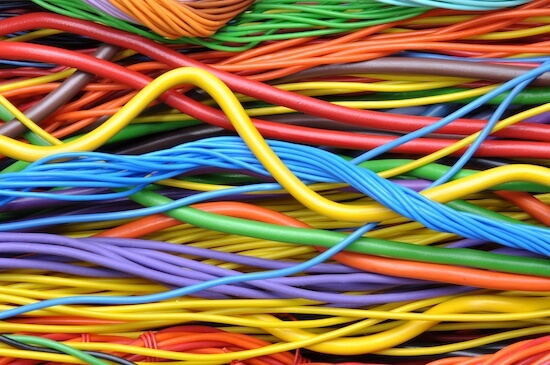
Wires or cables are often in different colors or otherwise marked or striped so that they can be easily identified. Some cable assemblies have exposed wires, while others are encased in a close-fitted protective sleeve.

Because of their sturdy design, cable assemblies are primarily suited for outdoor applications and for handling larger capacities of electric current. The durable structure of cable assemblies means that they’re able to withstand heat, moisture, abrasion, and other environmental conditions.

Cable assemblies help prevent damage to cables and wires by keeping them together and reducing the physical trauma from strong vibrations and other factors. They can also provide protection from other problems such as dirt, dust, oil, and water. This protection reduces potential problems with the machinery caused by wire being worn from vibrational friction along with electrical shorts occurring from damaged spots on the wire.

What Are Wire Harnesses?

Wire harnesses have a different build from cable assemblies. Wire harnesses are usually designed according to geometric and electrical requirements. A diagram is then provided (either on paper or on a monitor) for the assembly preparation and assembly. The wires are cut and respooled to the desired length, usually using a special wire-cutting machine. The wires may also be printed on or striped by a special machine during the cutting process or on a separate machine afterwards.

This is where the difference between a wire harness and a cable assembly occur. The ends of the wires are stripped to expose the metal (or core) of the wires, which are fitted with any required terminals or connector housings. The cables are assembled and clamped together on a special workbench, or onto a pin board (assembly board), according to the design specification, to form the cable harness. After fitting any protective sleeves, flexible conduit, or nylon binder, the harness is either fitted directly into the equipment on site or shipped. The wire harnesses themselves vary in applications and are more fragile due to the ends attached.

Even with increasing automation, the wire harness shares a similar trait with the cable assembly in that most of them are still hand manufactured due to the many different processes and ends involved in the vast array of varying applications and processes.

A wire harness is essentially a wrapping material that bundles up different cables together. Rather than binding multiple wires into a single strand (such as a Quik-Pull spiral configuration), a wire harness essentially groups distinct cables and wraps them together into a compound structure. Within a wire harness, each cable (or wire) is already individually wrapped in a dedicated sheath (or insulation). You can essentially pull out an individual cable (or wire) from a wire harness.

The primary purpose of a harness is to group together different cables for easier connectivity. They help keep electrical systems organized by preventing individual cables from running all over the place and allow for quick connectivity.

The wire harness material can be as simple as a nylon thread or zip tie (for grouping cables together), or it can be an external sheath that covers some of the wires and cables contained therein. It’s important to note that the sheathing in a wire harness is not designed to protect individual cables but to group them as a unit (similar to how the pull tabs in a Quik-Pull cable bundle function).

Because wire harnesses are not as durable as cable assemblies, they’re only useful for indoor applications. The load capacity of a wire harness is also limited to the number and size of cables that are grouped.

Two Important Distinctions between Cable Assemblies and Harnesses

Two important differences are in the structure and function.

1. In a cable assembly, the cables look and act like one thick wire. While each cable inside the jacket or sleeve may function separately, the product appears as a single thick wire.

A wire harness, on the other hand, is merely a grouping of separately sheathed wires. You can see each cable or wire within the wire harness. Consequently, individual internal components can be easily broken out and run in different direction.

2. A cable assembly is durable. A wire harness is best for indoor use.

The jacketing or sleeve applied to a cable assembly is designed for durability and stress-resistance (best suited for outdoor applications), while the coating on a wire harness is commonly made of electrical tape, industrial yarns, or a plastic not rated for sunlight resistance, wet conditions, or other environmental factors making them suitable for use only indoors.

Cable assemblies can be routed into tight and smaller spaces (due to the single durable construction of the assembly), while a harness tends to be more limited due to the individual cables contained in the structure.

Interested in learning more about harness options for an electrical project? Check out the different harnesses and bindings we offer

5 Steps to Calculate the Diameter of Bundled Cable

Download our infographic on calculating the diameter of bundled cable

One of the requests we frequently receive is to include an overall diameter (OD) of the customized cable bundles being quoted. This request comes up often since electrical contractors need to be able to estimate if their plans are in sync with one another, and a ballpark estimate gives them a sense that their initial assumptions and calculations are correct, or if they want to add a little margin of error in the costs of the conduit, or if they really have to crunch the numbers to ensure everything fits within the National electrical code (NEC) standards.

As an OEM that reprocesses premanufactured wire, we do not make the wire itself, and each manufacturer has its own tolerances in terms of OD for each wire jacket type.

Here we use averages of manufacturer specs to give us the ability to estimate the OD of the wire bundle for our own necessary calculations which is reel capacity. The calculation itself is a matter of mathematics, and with known data can be formulated and calculated using simple excel spreadsheets.

This calculation helps determine if the conduit planned is the correct size or not. The easiest way to actually measure the cable bundle is with a small measuring tool called an OD-Tape. OD-Tapes are used in the electrical field and plumbing fields to measure both length and overall outside diameter. To estimate the bundle, cut one 3-inch piece for each conductor in your bundle, tape them all together and use the OD tape to measure the outside.

Calculating the diameter might be as easy as measuring it using a more involved mathematical approach.

Here are 5 steps:

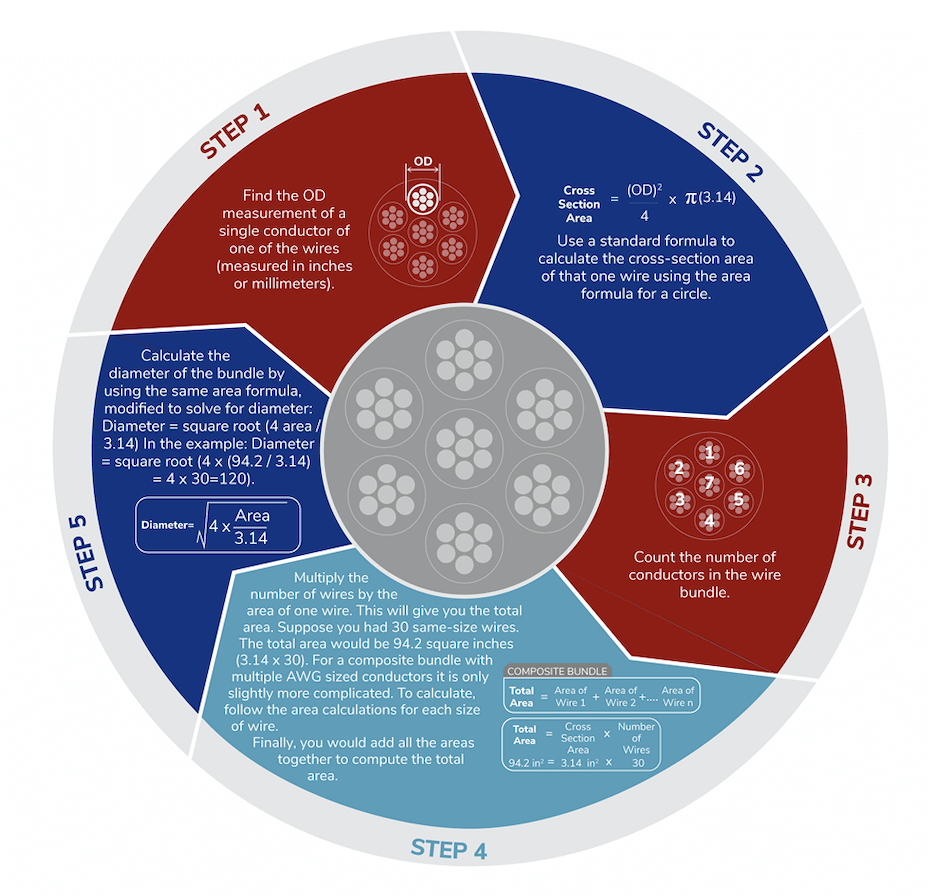
1.  Find the OD measurement of a single conductor of one of the wires. This measurement will probably be in inches or millimeters.

2. Utilize a standard formula to calculate the cross-section area of that one wire using the area formula for a circle, i.e., area equals the square of the diameter multiplied by 3.14 (pi) divided by four. As an example, a 2-inch wire would have an area of 3.14 square inch because 2 x 2 x 3.14 divided by 4 = 3.14.

3. Count the number of wires in the bundle.

4. Multiply the number of wires by the area of one wire. This will give you the total area. To continue the example, suppose you had 30 same-size wires. The total area would be 94.2 square inches (3.14 x 30). This example would be for a bundle of the same sized wires in the bundle. For a composite bundle with multiple AWG sized conductors it is only slightly more complicated. To calculate you simply follow the area calculations for each size of wire, that is, calculate one wire’s area and multiply it by the number of equal-sized wires (so if #14 is 10 wires then multiply the OD by 10; If #12 is 20 then multiply the OD by 20). Finally, you would add all the areas together to compute the total area.

5. Calculate the diameter of the bundle by using the same area formula, modified to solve for diameter: Diameter = square root (4 area / 3.14) In the example: Diameter = square root (4 x (94.2 / 3.14) = 4 x 30=120)

Diameter = square root (120) Diameter = 10.95 inches

(Note these ODs are not the actual OD of a specific AWG size, or type of any given manufacturer and each manufacturer OD may vary within UL tolerance guidelines)

Example: a composite bundle with varying AWG sizes: 3 x #14 (.140-inch dia.) 5 x #12 (.120-inch dia.) 1 x #8 (.250-inch dia.)

D = 1.2 v (3 x 1.19² + 5 x 1.40² + 1 x 1.65²)

(1.19²=.0196 + 1.40²=.0144 + 1.65²=.0625)

D = 1.2 v (3 x .0196 + 5 x .0144 + 1 x .0625)

D = 1.2 v (.0588 + .0720 +.0625)

D = 1.2 v (.1933) D = 1.2 x .4397

D = .5244

From our perspective as a manufacturer, this is what we need to calculate the fill capacity of the reels to spool the cable onto.

In the field, the electrical contractor has to use other formulas and computations to determine fill factors and OD changes for any given bend radius of the cable. Some cables retain their flexibility, others have push outs that widen the OD in one direction and flatten it in another. It is always good to review the numbers before ordering and pulling the cable into a particular conduit.

 Learn more about our various custom bundled cable configurations.

8 Steps for Pulling Wire Through Conduit

Pulling wire through conduit can be tricky for electrical professionals. The material of the conduit along with its length can be critical for determining the best approach for getting a wire or cable through one end and out the other side of the conduit.

As a bundled cable manufacturer, we frequently speak with electricians to understand how they go about difficult tasks such as pulling wire runs through pipes in difficult to reach places (like the area above a ceiling or below the floor in a commercial high rise) and what we can do to make the process easier. Before you get started you want all of your conductors together ready to enter the conduit. This can be done by setting up multiple reel jacks and pay out trees with enough space for every conductor being pulled, or you can start with having all the cabled printed and bundled into a Quik-Pull for single pulling effort.


Here are 8 steps for pulling the wire through conduit.

Step 1: Check your conduit

Measure the OD of the cable and the OD of the conduit to make sure it will fit. Measure the conduit from end to end to know its length. If the conduit length is longer than your fish tape, get a longer fish tape in order to proceed

Step 2: Use a pulling head or a pulling knot

Cut a small piece of wire AWG sized #16 to #12 depending on the size of the cable being pulled. Carefully separate the bundle into sides, place the wire in between and wrap in a figure-eight pattern a few times, then make a loop with the end. Tension draws the two sides together to tighten around the loop creating a small pulling knot.

Step 3: Usfish tape

When using a fish tape that is longer than the conduit, then you can insert your fish tape into  the conduit and push it until it comes out at the conduit end. Connect fish tape to the cable’s pulling head or pulling knot, and pull your fish tape through the conduit as the cable is fed into the conduit off the reel.

Step 4: Use wire Lubricant

Always use a lubricant (we recommend polywater G water soluble). Pulling lube will allow the cable to glide through the conduit by reducing friction, especially good for the longer “Home Run” pulls.

Step 5 – Use pulling tool

The easiest way to pull the cable is to use an electrical or mechanical pulling tool to assist the pull into the conduit.

Step 6 – Pull the wire through the conduit

After feeding the wire off the reel into the conduit and pulled at the other end. The cable should go into the conduit smoothly, with an easy effort. Add more lubrication for curves as needed.

Step 7 – Ring, Tag, Terminate

Bring the cables to the termination points. Then ring, tag, and terminate conductors into the panels.

Step 8 – Clean up

Clean up the mess, debris and job site.

Read more about our product configurations and wire types in our cable bundles.

What’s the Difference Between Wire and Cable?

There are fundamental differences between wires, conductors, and cables that determine when and how they are used. Being able to understand and clearly explain the differences can make planning an electrical installation job easier. To avoid confusion, we will focus on terminology related to uses in the electrical contracting industry.

What is Wire?

A wire is a single conductor, typically made of copper, aluminum, or sometimes steel (non – electrical use). The two main types of wire are solid and stranded.

Solid wire is made of one single strand of drawn copper, aluminum or other conductive metal into a long thin, still stiff, but bendable string like form. Solid wire has less resistance, so it is often used in applications that call for handling higher frequencies.

Stranded wire is comprised of multiple strands of solid wire drawn into ultra thin and flexible thread like filaments that can be twisted or braided together to form a single conductor comparable in size and weight to their solid counterparts. Stranded wire is often coated and is ideal for jobs that require more flexibility.

Conductor

Conductor is a term for wire or wire filaments that are not separated by coating or insulation. For instance, the twisted or braided strands of wire that make up stranded wire make up a single stranded conductor, once the appropriate jacket has been applied. As does the single solid wire strand once it has been jacketed. Single conductors can run smaller than 22 AWG and as large as the wires in the MCM classifications. They can consist of a single piece of wire or multiple strands of ultra thin wire (filaments), as long as every strand of wire is uninsulated and in contact with the other wires. 

Cable

When trying to define a cable the first thing one should always remember is that wire is a component of a cable. Cables are groups of two or more conductors made up of stranded or solid wire that are twisted, wrapped or otherwise bound together in some way. There are four main cable types:

Twisted pair cable: two cables that are twisted together. Twisted pair cables are often used in telecommunications industries, professional sound engineering, studios, theaters and intercom systems.

Multi-conductor cable: multiple cables grouped together and insulated from each other. The insulation reduces interference between the cables, which makes multi-conductor cables a popular choice for use in data transmission. Run together as a Quik-Pull bundled cable, they are ideal for running lighting, control and power circuits in the OEM market space and electrical construction industries.

Coaxial cable: constructed with a solid inner conductor and a surrounding outer layer foil conductor. The two layers are insulated from each other. These cables are usually used in the broadcast medias of television, radio and other forms of communication. Coaxial cable is slowly falling out of favor as multiconductor category/ethernet cables and fiber optic prices have come down in price and advanced the ability to transmit signals with less and less interruptions.

Fiber-optic cable: a grouping of wires that includes or is made entirely of optical fibers. Optical fibers are hair-thin wires made from glass or plastic that can carry more data faster than alloy cables. Fiber optics are the new wave of transmitting data, and communications but cannot replace copper cables all together because they cannot transmit power.

All of these types of cables may themselves be bundled to form a new Quik-Pull type of cable bundle for installation purposes.

Wire vs. Conductor vs. Cable

To wrap up, remember you cannot have a cable without conductors and conductors are made up of individual wire strands. The wire can be one thicker strand for a solid wire or finer strands (filaments), and a conductor can consist of a single strand of wire, to multiple strands, as long as, the multiple strands are not insulated from each other. And a cable is made of more than one conductor, and each conductor has to be insulated from the others.

Want to learn more about the differences between bundled cable configurations? Have a look at this article

5 Factors Impacting Bundled Cable Costs

Whenever we speak with electrical contractors and electricians about bundled cable, we are immediately asked “how much does it cost?” and “what are the overall cost savings for my project?”

The answer to these questions are not as simple as one may think since each project has its own set of individual requirements, and our solutions are customized to meet them. There are multiple factors that figure into the final quote price.

Whether pulling singles or pulling a bundled cable through a conduit on an install, the same core costs impact the quote:

  1. Wire costs
  2. Labor costs
  3. Delivery and freight costs
  4. Overhead costs
  5. Setup and cleanup costs

1. Wire Costs

First, and foremost, is the cost of the wire itself. If a project requires 100,000 ft of wire, then the cost of the project will reflect the price of the wire. If the wire only contains a small amount of copper, it is less expensive than wire that contains a significant portion. In most cases the larger AWG sized wire represents the largest cost on a project for both the electrical contractor and the manufacturer.  

2. Labor Costs

Manufacturing bundled cable requires hands on work in the form of labor. This can be a significant portion of the job costs, which depends on the size of the wire, the amount of connection to terminate, and other variable factors. If a customer needs the wire quickly and the OEM bundled cable manufacturer must have a shift team work overtime, then the OEM’s additional labor costs will be factored into the final price.

3. Delivery and Freight Costs

There is also the freight and 3PL costs for delivering the bundled cable to the job site. Some factors weighed are how quickly the electrical contractor needs the wire and also where in the country it is being delivered.

If electrical contractors need their bundled cable delivery quick, they can either add more labor costs in the form of more electricians on site to expedite the work per shift, or pay a manufacturer to make it and deliver it to the job site by a certain time frame.  From a factory perspective, delivery, whether LTL, full truckload, or self- delivery all have an identifiable cost associated with each job being shipped.

For the manufacturer, these can be expensive and run from as low of percentage of the cost as 5% to 6% to as high as 60%. Factors such as distance, size, weight, and minimal charges can influence the cost of delivery. Whereas the contractor may not necessarily think of the hours on the road, hourly wages, tolls, and wear and tear or rental costs to pick up material, the manufacture must include these costs.

4. Overhead Costs

The fourth factor is overhead costs which range from the costs of job trailers, to office space, shop space, to permitting/approvals.

From having all the right local, state, county permits, the correct job safety gear in place, the filing fees, engineering (etc…), some jobs can be a regulatory minefield that are expensive to get through, and more expensive if one attempt to cut corners. The known and stable costs of the business are factored into the hourly rate the contractor charges their customers. From a factory perspective, these costs are also stable and are spread out not in “job hours” but in “factory hours.” From the costs to maintain a UL approval license to rental of fork trucks, many of the costs for the manufacturer are the same month to month. The only variable costs not already covered are those of the reels, binder, tape, and other materials used to make the Quik-Pull bundled cable products.

Many of these are costs electrical contractors pay that are overlooked because they come built in to the products they are already buying.

5. Setup and Cleanup Costs

The fifth cost associated with a job is set up and clean up. From the manufacturer’s standpoint, this is not as significant as it is to the contractor. For instance, at the factory when the job is done there is a little cellophane to recycle, maybe an empty reel or two to recycle, or a fiber board barrel to recycle (usually filled with wire scraps to be recycled).

But from the electrical contractor’s perspective, set up and clean up costs are significant. When it comes to setting up multiple reels, it can take time. With bundled cable, the bundled conductors are on a single reel but it still take time (and hence money) to get the reels from the truck to the right position on the job site. However, bundled cable on a single reel eliminates all of the man hours required for unloading multiple reels of material.

The multiple barrels or reels the factory recycles are a disposal cost for the contractor. The small bits of wire here and there are thrown in the dumpster and add pounds to the overall tonnage and thereby the costs, the packing and warehousing of left over useable wire also drive up labor costs for the electrical contractor since he or she now need to devote labor time to cleaning up the job site.

Looking at the Whole Picture

To summarize, the total costs of bundled cable and its final cost-savings for an electrical contractor include  number of variables. Each quote is unique and will vary based on the factors listed above.

To learn more about the cost-saving value of bundled cable, check out our price comparison page.

What Are Pull Tabs?

Whenever one of our sales reps speaks with a customer, they typically let them know that our wire bundles come with multiple binding and harness options, one of which is pull tabs. The most common response to this question by both electrical contractors and electrical distributors is “what are pull tabs?” 

In short, pull tabs are small pieces of low residue electrical tape that wrap around a group of conductors to hold them in place. Sometimes they are referred to as quick release tabs or cross tape. Applied at premeasured intervals and wrapped around all the conductors, the pull tabs hold our bundled cable together. This option would be used instead of a nylon, aramid, or kevlar binder. 

Why do electrical contractors choose pull tabs? It is often a preference based on the layout of the conduit. Some, customers prefer a nylon binding while others do not. Some customers dislike the nylon binding’s potential to get caught in a bend or snagged on a minor conduit imperfection when it is pulled. While there are ways to reduce these occurrences with how the binder is applied around the bundle, the easiest way is to have the wires flow loosely as if they were single conductors once in the conduit.  

This is where pull tabs excel, as they give the benefit of pulling the cable all together to start, but then the wires are separated as the pull continues. The pull tabs offer a quick release, and since the electrical tape leaves no adhesive residue, the conductors will not stick to each other or the conduit as the cable is fed into the conduit. This allows each conductor of wire to flow as if single conductors were being pulled, eliminating the stiffness that a tighter bound nylon harness would have. Pull tabs give an electrical contractor a sense of a hassle-free pull. That said, though most pulls using the nylon harness go through smoothly, they always have the potential to bunch or snag if too much binder is applied or the harness is exceptionally tight.  

The pull tabs are the best alternative to the textile binders as the electrical tape pull tab doesn’t cover as much surface space as a nylon harness. The tabs are removed before entering the conduit leaving no adhesive residue to cause additional friction during the pull. Another advantage of having the bundle undone and the wire flowing loosely as it is fed into the conduit is that each conductor bends naturally and is pushed around imperfections as it is pulled. With a nylon binder, the bundles held together are stiffer and the bend radius is less, so pulling through corners and bends may create more friction.  

Additionally, the bending pressure may cause “pop outs” of a few conductors in the cable or the binder can get caught on any imperfections that loose conductors naturally flow around making it more difficult to pull.  

So why not just go with pull tabs? The major disadvantage is that the pull tabs in most places cannot be pulled into the conduit. If they could, they might snag, get pulled off, and collect in the conduit to form a blockage, much like those that form in sewer lines. This coupled with the manpower needed to remove the pull tabs slows down the install, whereas the tighter nylon bound bundle is just pulled end to end.

If you want to learn more about the electrical bindings, have a look at our article on the advantages and disadvantages of different wire bundled bindings.

Riser Vs. Plenum Rated Bundled Cables 

By Rudy Hanecak

Inside Sales
One-Pull Wire and Cable Solutions

There are some crucial distinctions between riser and plenum rated cable bundles. Most commercial spaces will have to use either plenum or riser rated cables to meet fire safety codes.

Plenum rated cables are used in plenum areas meant for use in commercial and residential spaces. Plenum spaces are the spaces between the ceilings and the floors above it (drop ceiling) that are used for creating pathways for heated/air conditioned or return air flows. The importance of these spaces for air circulation create a greater hazard if a fire were to occur, both in regards to the growth of the fire and the spread of smoke from the materials burning in the space which may contain toxic chemicals under high heat that are carried in the smoke.

Plenum cables have a higher fire rating and are designed with fire-retardant plastic jackets of either a low-smoke PVC or a fluorinated ethylene polymer (FEP). This decreases the likelihood that the cables burn quickly, thereby spreading toxic air through the building during a fire as people try to evacuate.

To be rated as plenum, the outer jacket of the cable needs a specially treated jacket insulating the wire to meet NFPA and NEC standards. Plenum cables are usually designated with the letter CMP where the “P” stands for plenum.

Riser cables, sometimes referred to as “backbone” cables, are the cables run vertically from floor to floor in a structure. They “rise” through cable spaces or in elevator shafts in non-plenum areas. The riser space is the term given to any vertical shaft or series of rooms within a building that allow primary utilities such as electrical conduits, water supply lines, and communications cabling to be distributed vertically.

For communications cabling, the riser could be a separate room on each floor, or a room shared with the electrical gear. In either case, the room is self-contained and not used for recirculating air to the HVAC system. Thus, the fire safety requirements for materials installed within these rooms is less stringent than those of plenum spaces. Like plenum, the riser must also meet certain NFPA standards. These cables must self-extinguish if caught on fire by a spark in order to prevent the flame from traveling up the cable.

The Cost Difference Between Riser and Plenum Bundled Cable

Since the requirements for riser space and plenum space are different (with those requirements for riser cables being less strict compared to plenum ones), plenum cable can replace riser cables as they meet the minimum safety specifications.

We would not recommend bundling plain PVC cables that do not meet either riser or plenum requirements but would suggest having them printed and labeled if the customer requires organized cables that can be easily identified.

We would also suggest spending the little extra for peace of mind and adding a level of safety to the install.

To summarize the difference between PVC and plenum and riser rated cables are cost and fire protection. While the cost is a major factor, it boils down to a matter of how fire-resistant you want your bundled cables to be and how much smoke is emitted if they do burn. And in many instances the code decides for you.

Want to learn more about our cable bundles? Check out ourcustom configurations.

What Is the Max Size of a Wire Bundle?

As a manufacturer of custom cable assemblies, electrical contractors and electricians will ask us “what’s the largest bundled cable reel you manufacture?” 

Though we’d like to say the sky is the limit, there is a maximum size. There are three main limiting factors: 

1) Bundling wire equipment has a maximum OD size

The take up is limited to the size of reel it can handle (currently 68 inch reels). The reel and equipment itself can only support so much weight. Our take up can pull a maximum of 3,200 pounds. This means that even if the reel can support 4,500 pounds it would not be possible to respool the cable onto the reel with the current equipment because the power needed to pull that much weight exceeds the physical capabilities of the equipment. 

2) Cable Bundles Eventually Become Less Bendable

Wire and cable bundles begin to lose their flexibility once the number of conductors exceeds certain limits. These limitations can be extended by moving from a straight configuration to a spiral configuration, and by changing the wire type to greater stranding counts (from solid to stranded being the most noticeable), but eventually the maximum number for all cables will be reached.   

3) Ability to Transport the Wire Bundle on the Job Site

Even if the OEM could manufacture a 20,000-pound wire bundle on a 500-inch reel, the end user (typically an electrician, mechanical engineer, lead technician, etc…) must have the ability to move the reel around the job site and set it up for use. To this end, most requests ask for reel sizes that fit on their job site and are light enough to be rolled by hand or moved with a simple pallet jack or hand cart. 

This last point is important. Say an electrical contractor working on a solar farm project orders 30 reels of PV wire, each one containing 80 conductors in a staggered configuration assembly. For a wire bundle to be useable, the electrical contractor needs to be able to unload the reels off the truck and then move them to the specific installation site.  

If the reel is so large that the electrical contractor’s team can’t maneuver the bundle around the site, then the reel is essentially unusable. Our flexibility and 3,200-pound limit mean that contractors, if prepared, won’t ever have trouble unloading the reel itself.  

Different wire types have their own wire bundle limitations as well. For example, with data cables, such as Cat5 and Cat6, the bundle sizes are generally determined by the port count of patch panels which are either 12, 24, and 48 port panels. Furthermore, certain wire types have a maximum cable count per bundle based on the engineering test specifications that electrical contractors must adhere to when they design and select their custom cable assemblies.  

To summarize, wire bundles must be portable enough so that an electrical contractor can transport them around the job site. The manufacturer’s cable bundle size limitations are determined by the practical needs of the electrical contractor’s team.   

Curious to learn more about the specific size of a wire bundle for a project? Send us your question and we will get you an answer. 

3 Obstacles Facing Electrical Contractors in 2020

Throughout my travels in the United States as a national sales manager at a bundled cable manufacturer, I’ve talked with many electrical contractors and partnered with them to meet their bundled wire needs. I regularly receive requests from electrical contractors working in a variety of projects including data centers, multi-conductor homeruns in sports stadiums, wire bundles for acreages of solar farms, as well as cable bundles manufactured for airport automated conveyor belts systems (to name a few).   

During that time, I’ve listened to the challenges that they encounter. Though electrical contractors deal with unique problems depending on the scale of the project and specific industry (such as commercial high rises, water treatment facilities, fire alarm systems, etc…), their main challenges are similar across construction projects. 

Here are the 3 biggest obstacles I’ve been hearing from electrical contractors on the job site that will continue to persist in 2020. 

1) Being Competitive on Job Bids 

For much of the electrical construction industry, profit margins are narrow. The average margin for general contractors is between 1.4% and 2.4% whereas for subcontractors it is slightly higher at between 2.2% and 3.5%. 

Electrical contractors frequently ask “how do I stay competitive on job bids while making sure we don’t undercut our margins?” 

Fortunately, there are solutions out there to solve this critical business problem. In fact, our company’s mission is to help electrical contractors increase productivity and save time on every installation with our bundled cable products. Our custom cable bundles are designed to enhance and speed up installations on the job site so that electrical contractors can get the job done and then move onto the next one quickly and efficiently.  

Additionally, technology is also bringing about new solutions that are simplifying life for electrical contractors. There is estimation software to facilitate better forecasting and getting the job assignment completed under budget. Collaborative communication tools like Microsoft Teams and Slack speed up communication, critical for when a project manager sees a problem and needs to communicate with other members of the team that either aren’t on the job site or aren’t right around the corner.   

 2) The Challenges of Staying on Schedule 

In general, the electrical construction industry is plagued with scheduling issues and conflicts on construction projects. The spread of BIM (building information modeling) software has helped contractors and subcontractors to align their plans at the start of construction to help avoid oversights, but scheduling problems continue to hurt the bottom line for electrical contractors. 

Given the thin profit margins discussed above, it is critical for electrical contractors that they stay on schedule (ideally under!). Therefore when a job goes over schedule, not only do electrical contractors’ slim margins already take a hit on the task at hand, they are prevented from moving onto the next job opportunity. 

 3) Shortage of Qualified Electricians 

A labor shortage of trained electricians will continue to impact large and small shop electrical construction companies. Their ability to grow is contingent on their ability to recruit.  

Studies have shown that the average age of electrical contractors has been steadily increasing. In 2016, the average age was 57.3. In 2018, it increased to 58.2.  

There’s no easy solution to fix the electrician labor short fall. However, in addition to vocational schools boosting their recruitment efforts, electrical contractors could explore ways to increase their recruitment activities on college campuses.  

Especially because of the soaring costs and interests rates on student loans, recent graduates are looking for jobs that pay good salaries soon after graduation. Electrical contracting work pays well and this could be turned into a recruiting pitch for electrical contractors. 

These are just a few of the prominent concerns I regularly hear about. Though they won’t be solved overnight, solutions are being developed. I’m excited to see how they will be adopted in the years ahead.

Want to learn more about how bundled cable can help as a cost-saving solution? Contact us or email quotes@onepull.com for more information.

The Differences Between Bundled Cable Configurations

Each electrical installation project has its own unique demands. Our custom bundled cable configurations are manufactured with these demands in mind. For example, a Cat6 cable bundle for a data center application will require a different configuration from, say, an 18 conductor THHN bundle that will be used in for controls in automation equipment. 

Whether an electrical contractor will use a bundled cable configuration in an automated conveyor belt systemwater treatment facility, or fire alarm system, network, or data center will factor into their configuration preferences. 

Specific configurations are designed to solve the problems faced by electrical contractors in specific installations. Since labor costs associated with each installation will reduce an electrical contractors overall profit margins, their choice for a bundled cable configuration is critical for their bottom line.  

Depending on the project, different configurations are better suited to maximize efficiency and time to completion on the job site. 

So when would an electrical contractor choose a spiral, staggered, or straight configuration? 

1) Spiral Configuration

Spiral cable assemblies are great for electrical installations where the minimum outside diameter and maximum flexibility are required (such as home runs) to be run through conduit with numerous or sharp bends.    

Though the binding is very compact, spiral configurations maintain a round shape that maintains the flexibility qualities of the wire contained in the bundle which helps to prevent hang ups.  

Additionally, spiral cable bundles do not change their proportion when bent. 

It is often used for long pulls in conduit where all conductors will be carried end-to-end, or numerous bends in the conduit could cause hang ups

Common applications: 

  • Control Systems 
  • Communication Systems 
  • Industrial Automation 
  • Commercial Construction 
  • Access Control Systems 
  • Solar Farms 
  • Automated Conveyor Belt Systems

2) Straight Configuration

Straight configurations are often used for assemblies laid in place such as composites of electronic cables (both with or without building wire).  

Straight bundled cable configurations are often used in home runs as well as in conduits and trays. It is not uncommon for them to be used in an un-spiraled structure to minimize heat build-up in power wires 12 AWG or larger.  

Though less flexible than a spiral configuration, a straight configuration works just as well as a spiral assembly so long as flexibility is not a primary concern for an electrical contractor. 

Straight configurations are available for wire types that include coax, fiber optic, data and build/fixture wires. 

Common applications: 

  • Power plants 
  • Commercial Offices 
  • Casinos 
  • LED Lighting Systems and Fixtures 
  • Waste Water Treatment Facilities 
  • Generators 
  • Theater Lighting 
  • Hospital call systems 
  • Data Centers 
  • Warehouses 
  • Factories 
  • Ventilation and HVAC Systems 

3) Staggered Configuration

Staggered bundle cable configurations are used in installations where the exact measurements of breakout points can be specified at the time that the order is placed. 

The breakout conductors can have various length tails and be bundled at one or both ends.  

Staggered configurations are commonly used in solar farms, commercial and roof top installations, elevator and lift systems, and conveyor automation machines. 

Common applications:  

  • Solar Farms 
  • Data Centers 
  • Fire Alarm Systems 
  • Security Systems 
  • Elevator and Lift Systems 
  • Rooftop installations 
  • Automated Conveyor Belt Systems 
  • Manufacturing assembly lines 

To learn more about our various configurations and their applications, visit our configuration spec sheets