Blog

Different Types of Industrial Automation Systems

Industrial automation refers to computerized systems within manufacturing that handle different processes and machineries in place of human involvement. Most of the processes handled by such systems would be perceived as being repetitive, mechanical, or in other cases, both.

With modernization and technology, industries have started adopting automated systems to increase efficiency and productivity at work. The vast adoption of these systems has seen the industrial automation market growing globally reaching 127.04 billion dollars in 2018 and expected to grow to a staggering 296.70 billion dollars in 2026, according to Fortune Business Insights.

While these statistics show an increasing adoption of automation systems, they do not break down the numbers to the widely varying automation systems that exist. How then would you know what automation system is the right one for your business?
The right automation system for your business is determined by the labor conditions, competitive pressure, manufacturing and assembly specifications, work requirements and the cost of labor. Below we highlight the different types of automation systems, and the industries they are typically found in.

By looking at the types of systems mentioned below and considering the factors mentioned above, you should be better suited to pick the right automation system for your business.

Types of Automation systems

1. Fixed Automation

Also referred to as hard automation, fixed automation systems carry out a single set of tasks without deviation. Because of its function, this type of system would typically be used for discrete mass production and continuous flow systems. An example of a fixed automation equipment would be an automated conveyer belt system designed to increase efficiency by moving objects from point A to B without minimal efforts. Just like all other fixed automation system equipment, automated conveyer belts perform fixed and repetitive operations to achieve high production volumes.

Manufacturing processes compatible with this system would be:

  • Repetitive manufacturing which allows for variations within the manufacturing process although limited (e.g. in food packaging or the textile industry)

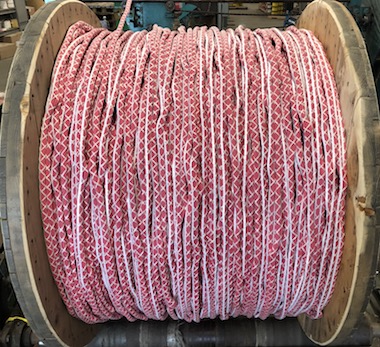
Adopting a fixed automation system such as automated conveyer belts and including value-added solutions meant to cut both time and labor costs in their installation, eases off competitive pressure for your business, increases your profit margin, and keeps you one step ahead of the competition. An example of a value-added solution would be using bundled wire for automated conveyer systems. This not only cuts down installation time, but also lowers labor costs and keeps employees safe from injuries associated with pulling wire during installation.

2. Programmable Automation

As the names suggests, programmable automation runs through commands delivered by a computer program. This means that the resulting processes can vary widely with changing instructions given to the computer through a series of code. However, as the programming efforts are non-trivial, the processes hence the tasks do not change much. This type of automation is common in mass production settings which produce similar types of products that utilize many of the same steps and tools like in paper mills or steel rolling mills.
Manufacturing processes compatible with this system would be:

  • Repetitive manufacturing whereby the same products are being produced over a long period of time and in large batches. These types of equipment can keep carrying with very little human supervision. They are typically used in automobile and machinery manufacturing.

The initial set up of programmable automation equipment may require a high cost but because the processes are continuous and relatively unchanging, they tend to be less expensive in the long run.

3. Flexible Automation

Also referred to as soft automation, this type of automation is utilized in computer-controlled flexible manufacturing systems and allows for a more flexible production. Every equipment receives instructions from a human-operated computer which means that the tasks can vary widely with changing code delivered to the computer. This type of automation would typically be used in batch processes and job shops with high product varieties and low-to-medium job volume, such as in textile manufacturing.

Manufacturing processes compatible with this system would be:

  • Discrete manufacturing which allows for variations within the manufacturing process although limited e.g. in food packaging or the textile industry.
  • Job shop manufacturing which occurs within set production areas and is more labor intensive compared to other forms of manufacturing. An example would be making custom machinery.
  • Batch process manufacturing whereby raw materials move through the production line in batches such that there is a pause between each step as a batch moves through (e.g. in the pharmaceutical industry and in paint manufacturing).
  • Continuous process manufacturing which offers consistent processing as the manufacturing process from beginning to end does not change. This type of manufacturing is commonly used in food and beverage manufacturing as well as oil and gas manufacturing.

4. Integrated Automation

Integrated automation involves the total automation of manufacturing plants as it is entirely handled by computers and control processes with minimal human involvement. Computers can design the necessary parts, test the designs, and fabricate the parts. Integrated automation, like flexible automation, is compatible with both batch process manufacturing and continuous process manufacturing.

Technologies that use this type of automation include:

  •  Computer-aided process planning
  •  Computer-supported design and manufacturing
  •  Computer numerical control machine tools
  • Computerized production and scheduling control
  • Automatic storage and retrieval systems
  • Flexible machine systems
  • Automated material handling systems, e.g. robots
  • Automated conveyor belts and cranes

Learn more about 5 U.S companies that are leading the charge in the manufacturing of automated conveyor belt systems 

5 Problems Facing EPC Companies

Download our new infographic on problems facing EPC companies.

Working in any industry presents several challenges and the construction industry is no exception. For instance, being one of the industries most resistant to change, the construction industry has had to deal with scheduling issues and technological shortcomings — the effects of which trickle down to productivity of workers within industry and bidding issues. These are just some of the many challenges impeding the construction industry.

Here are some more challenges worth looking into:


1. Labor shortage

As per data verified by the Job Openings and Labor Turnover Survey in 2009, the US labor shortage within the construction industry is 350,000; meaning that the industry is short of 350,000 workers. This shortage came about as a result of the 2008- 2009 recession which saw about 2 million workers exit the industry and not returning since. The growing shortage of workers has been identified as one of the biggest threats facing construction, an industry that heavily relies on labor.

Besides the recession, the lack of skilled workers and age have also contributed to the labor shortage. For instance, age has been identified as a looming threat to the industry. Finding skilled workers has proven to be very challenging as the old workforce retire leaving behind a gap to be filled by millennials who would prefer to pursue a college education or work in retail or transportation. 

Some of the problems that accompany the labor shortage are:

  • Longer project completion times
  • Additional costs over the lengthened duration of the project
  • Decreased productivity

Since the construction industry is a big part of the U.S economy (accounting about 6.36% of the U.S economy according to a report in 2017), it is essential to address the issue of labor shortage.


2. Communication


© lev dolgachov


Among EPC (Engineering, Procurement, and Construction) companies, a single project could be spread out over several teams from the engineering team to general contractors. Construction projects are a mass collaboration requiring high cross-team communication.

However, these teams tend to be highly fragmented and working in silos presents a major challenge if there’s a lack of cross-team collaboration. This breakdown of communication not only lowers productivity but could also be financially costly.

Additionally, the lack of a streamlined means of communication can be costly. A lot of documentation is done via paper making it difficult for follow ups by the various teams and making it even harder to learn any historical information about the project at hand.

Choosing the right method of communication among all project stakeholders and making sure it is streamlined is vital to the success of any construction project. Investing in technology for communication management could also see an increase in project productivity and accuracy of project information. Of course, training in such technology would be required to ensure its implementation success.

Examples of communication technology include:

  • Slack: an instant messenger chat tool for companies in which you can easily create chat groups, review past conversations, and share documents within groups.
  • Microsoft Teams: similar to Slack but included in the Microsoft Office suite.
  • Trello: a project and task management tool that organizes your team’s projects into boards.
  • Asana : a tool designed to help teams organize, track, and manage their work.
  • Monday.com: a project management tool that could also be used as a CRM.


3. Shrinking profit margins


declining profit margins
© by Maksym Bondarchuk


There is a gradual reduction in profit over time within the construction business. A 2019 study showed that although gross profit margins between 2008 and 2012 were rapidly increasing from 10% to about 20%, they began rapidly declining after 2014. Analysis of the results of this study revealed that nearly 1 out of every 2 projects will result in a loss. These numbers are quite shocking and paint the devastating picture of shrinking profit margins in the industry. This is not a problem that is experienced by large contractors as small general contractors and subcontractors are equally harmed by the reducing profit margins.

Since this is an issue pointing to the numbers, to ensure increased average profit margins, construction business owners need to pay attention to metrics impacting their profit margins. Some of these include profit, equity, job costs and estimates, cash flow, liability, contracts, sales, overhead, and receivables. Business owners need to make sure that they really understand these metrics and how they play out in their business including how to alter them to ensure their profit margins increase.

Read more on how to increase your profit margins using these metrics. 


4. Safety on construction sites


(c) Oleksii Yaremenko | Dreamstime.com


Construction work is known for its reliance on highly physical and manual labor. Construction sites present many hazards to their workers. Injury rates on workers in the construction industry is higher than the average of all other industries— the industry reported to have the highest accident rate of all other major industries, with the annual resulting cost estimated at $12 billion. Construction activities such as lifting, pulling, bending, or pushing could result in injuries that last a lifetime further reducing productivity within the industry and increasing labor shortage.

Employers should prioritize the safety of their workers and implement safety measures on construction sites (such as providing equipment for fall protection or requiring employees to wear a body belt attached to their booms or baskets when working from an aerial lift).

Some value-added services meant to lower costs and time for construction projects could also serve to reduce injuries among construction workers. For example, pulling wire has been identified as one cause of injury. For electrical contractors, this comes in the form of pulling wire through conduit which can be quite strenuous and cause back injuries. Value-added solutions such as bundled wire could not only lower labor cost for construction projects and save time, but also keep employees safe from injuries.


5. Rising material and labor costs

Construction pricing fluctuates. In 2018, the construction prices increased 5.07%. This fluctuation in prices is attributed to rising material and labor costs. For example, prices of copper and aluminum fluctuate as a result of commodity trading, making the prices of wire and cable conductors fluctuate. Labor costs, on the other hand rise even more with the existing labor shortage. Having long term contracts can ensure protection against price fluctuations helping to mitigate high labor costs for contractors.

An option to consider to lower material and labor costs in this case would be value-added services and solutions. Value-added services help reduce time and involvement in a project resulting in lower costs to help maintain a stable profit margin. For contractors, these would mean less time on one project and the ability to spread out their time on other projects — consequently increasing their income potential. Examples of these services include paralleling, pulling heads, cut to length services and vendor managed inventory. 


Learn more about One-Pull’s bundled cables as a value-added solution and how these cables could save you time and money on your next construction project.  


5 Innovative Automated Conveyor Systems Manufacturers

The global conveyor systems market was $5.23 billion in 2019, and is projected to reach $7.43 billion by 2027. That’s a compound annual growth rate of 4.6%. While historically the industrial and construction sectors have been the main drivers of conveyor system technology, the past few years have seen new demand in e-commerce, food and beverage, and pharmaceuticals.

Our bundled cable has an array of applications in the wiring for automated conveyor belt systems. Below we’ve highlighted 5 U.S. companies that are leading the charge in the manufacturing of automated conveyor belt systems.

1. Hytrol

Headquarters: Jonesboro, Arkansas
Founded: 1962

When you look at the top 5 industries driving the automated conveyor belt systems market, Hytrol is an industry leader in three of them: pharmaceutical, food and beverage, and manufacturing. A fourth specialty of Hytrol’s is e-commerce, which is one of the primary reasons the conveyor belts system industry is projected to grow over the coming years.

2. BEUMER Group

US Headquarters: Somerset, New Jersey
Founded: 1935

Bundled wiring helps expedite the process of getting the wire installed in material handling equipment, such as the type of equipment the BEUMER Group manufactures.

BEUMER Group has locations all over the world. They have 4,500 employees and have annual sales at over $1.1 billion. It’s not just BEUMER’s size that sets them apart, but also their specialties: whereas most of the conveyor industry is being driven by consumer packaged goods via e-commerce, BEUMER focuses heavily on the industrial sector. Mining, chemicals, cement, and ports are several examples they highlight.

3. Bastian Solutions

Headquarters: Indianapolis, Indiana
Founded: 1952

Bastian Solutions is one of the largest independent material handling integrators in the world, and they’re also a Toyota Advanced Logistics company. Bastian works with their customers’ specific needs to develop customize solutions. With every project and installation being unique, this is another use case where bundled cable would be a perfect time, material, and cost-saving value-added solution.

4. Dematic

Headquarters: Atlanta, Georgia
Founded: 1819

Dematic is USA-grown global powerhouse in automated conveyor systems. Headquartered in Atlanta, they have 60 engineering facilities in 25 countries, employ more than 7,000 people, and have installed over 6,000 systems.

5. Key Technology, Inc

Headquarters: Walla Walla, Washington
Founded: 1948

Key Technology has a unique specialty: conveyor systems for food processors. Key aims to increase yield, efficiency, and profit for their customers with an expansive range of products for every use case. To fill every need a client may have, their conveyor belts work together from transport to sorting to packaging. They’ve even adapted their products to the needs of the pharmaceutical industry. With locations in Washington, Oregon, and California, Key Technology is a strong automated conveyor belt systems solution for the right project.

Most modern automated conveyor systems projects have one thing in common: their use cases aren’t exactly the same as anyone else’s. Like most industries in 2020, conveyor belt systems are adapting to meet new challenges. Bundled cable is sorted, bundled, labeled, and cut to meet the fast-changing needs of businesses and the machines that make them tick.

Learn more about how bundled cable can help electrical contractors save time in installing wiring in automated conveyor belt systems.

Should You Choose a Straight or Spiral Configuration Quik-Pull?

We manufacture a variety of Quik-Pull bundled cable configurations designed to meet the needs of electrical contractors in a range of markets including data centers, automated conveyor systems, solar farm construction, water treatment facilities, and more. Customers will often ask us what are the different applications of a straight versus a spiral configuration.

We are the only manufacturers of the spiral configuration so it is common for us to receive customer inquiries about this unique bundled cable assembly.

Here’s a quick overview on some of the differences and their specific industry uses.

Spiral Bundled Cable Configuration

Spiral Configuration

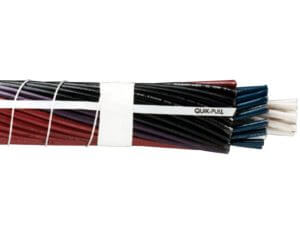
A spiral configuration is a multi-conductor, spiraled together creating a highly flexible cable bundle.

The spiral configuration’s harness and assembly enables it to maintain its roundness in almost all pulls. It is perfect for long pulls where wires must travel along the same path.

The spiral configuration bundle is ideal for “Home Runs” that need to be pulled through conduits, raceways, and gutters. The nylon harness maintains the bundled wirings flexibility while still ensuring that the conductors have enough room to breath.

The spiral configuration assemblies are the most flexible custom bundled cables on the market. Because the spiral configurations retain their roundness and do not change their proportion when bent, they have the lowest chance of hang ups.

Because the spiral assembly preserves its flexibility and roundness under most conditions, it is easier to pull long distances.

INDUSTRY USES:

  • For long pulls in conduit where all the conductors will be carried end-to-end.
  • Where minimum outside diameter and maximum flexibility are needed.
  • Where the overall assembly is to be jacketed.


Additional info:

  • The minimum footage per order is 100 feet.
  • The wrap is a standard spiral wrap.
  • The maximum overall diameter possible is 1.48” (if your OD is larger than this, you would want to choose a straight configuration below).

Straight Configuration Bundled Cable

Straight Configuration

In the straight configuration, conductors can be broken out at unspecified and intermediate points along their run with up to 200 conductors on pull-length reels. 

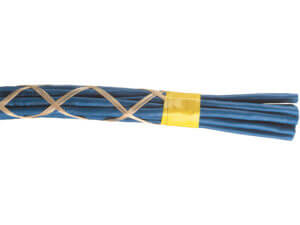
The straight configuration consists of individual conductors that can be easily broken out at intermediate points along the run.

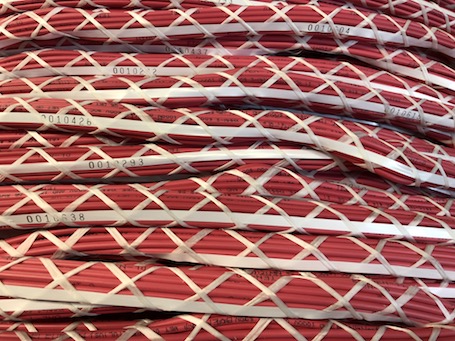
In a straight configuration bundle the conductors are laid parallel with no twists. They are ideal for bundles laid in tray, troughs, or other wire management systems where there is no conduit. There is custom printing of any alpha numeric combination along the entire length of the conductor every 1” to 6.”

Since there is custom marking and bundling, all set up on a single reel, this bundled configuration speeds up tray installations while also ensuring there is no left over wire to clean up or left over as surplus inventory.

INDUSTRY USES

  • For composites of electronic cables with or without building/fixture wires.
  • Where conductors will be broken out at intermediate points along the run.
  • Where the assembly will be laid in place, not pulled (wireways or raceways).


Additional info:

  • There is no minimum footage requirement.
  • The wrap is standard double cross, with optional taped pull tabs for OD’s up to 1”.
  • When the overall diameter is 1”or higher, taped pull tabs is recommended.
  • The maximum overall diameter possible is 2.1”.

Visit our bundled cable configurations page to learn more about our different cable assembly options.

Emerging Markets for Electrical Contractors in 2020

Solar Energy Industry

Solar energy industry trends have been showing steady growth for years, but now the solar industry is adapting to the challenges of the Covid-19 crisis. This is the first economic recession the solar industry has had to face since becoming a mainstream product. Many major solar energy companies are offering substantial incentives, and you could leverage these incentives as a selling point to your clients. 

In addition to the incentives being offered by solar companies, there’s also the Federal Solar Investment Tax Credit (ITC). The tax credit is 26% through 2020 for solar energy projects, and is currently scheduled to decrease to 22% in 2021. The tax credit and company incentives together make an enticing opportunity for electrical contractors and their clients, but they’re also both time limited to take advantage of. This may add the pressure of time, but there are tools and systems electrical contractors can use to save time and labor on even the most sprawling solar energy projects

Government Investment in Public Works

Government spending will increase as a way to revitalize the economy, and historically a lot of that spending lands in construction. These construction projects usually involve projects like road repair and construction, main electrical grid updates, street lighting, and public works updates such as parks.

There is also an attractive opportunity for electrical contracts for institutional buildings, such as schools, government agency buildings, and, of course, hospitals. These types of projects currently account for 19.3% of revenue in the electrical contracting industry, and that number is only going to grow with increased government spending.

Smart Cities

While smart cities may sound like the types of projects that would be put on hold during a crisis, there are a lot of practical benefits to them that will become even more important in the wake of Covid-19. Many smart city initiatives are attempts to answer serious problems, such as rapidly increasing city populations with minimal public resources and staffing to compensate for them. Crises like Covid-19 only make these problems more immediate.

Some of the government spending outlined above is going to go to smart city projects. This is a good time to highlight the government contracts you’ve worked on, all of your IoT implementation experience, and any public infrastructure work. 

You can also try reaching out to universities in the cities where you want to work. A lot of smart city projects are run through universities, and they either hire contractors themselves with grant money, or can put you in direct contact with decision makers.

Facilities Services

Most electrical contracts come from new construction projects, but there has been a decline in nonresidential and residential construction in 2020 due to Covid-19.

This creates an opportunity to focus on specialized maintenance, repair, and updating services, or “facilities services”. More companies have been investing in upgrading their existing electrical systems, and these investments are not expected to be hit as hard as new construction initiatives.

Lighting systems are an example of a facilities service that’s still in demand. You should consider emphasizing your experience in upgrading lighting systems to LED and energy-efficient systems, as well as updating lighting systems to smart lighting systems. Familiarize yourself with smart lightbulbs and IoT lighting system devices that are current market leaders so you’re ready to start making educated recommendations to your clients. If you’re including solar energy in the job you can take advantage of the government support mentioned above.

Check out our custom bundled cable configurations.

Smart Cities Generating Electrical Projects

Smart city initiatives serve a more immediate purpose than just staying modern. A lot of cities that launch smart city strategies are major metro areas that are anticipating significant population increases over the coming years, with no increase in government staffing or workers. Implementing smart city technology is therefore becoming a “must have” for some cities. And they’re going to need electrical contractors to get them implemented.

1. Seattle, WA

Publicly Available Data

Seattle’s government has made over 1,000 data sets publically accessible. The data is all about how Seattle functions as a city: crime tracking and public safety, transportation, education, finance, and more. This encourages and equips companies that want to launch smart city initiatives in the city. Smart city technology focuses on flexible solutions that adapt to the changing environment they’re implemented in. And the amount of available data will only increase: Seattle is currently pursuing the Array of Things project, which will install tracking devices around the city to produce real-time data on environment and infrastructure. Making data public like this not only encourages new smart city projects, but helps to ensure their effectiveness and longevity.

MetroLab Network Member

Seattle is a member of the MetroLab Network. This is a national network of city-university partnerships with an emphasis on engineering and computer science, and in 2015 the University of Washington and the City of Seattle became members. Every project they launch through this program has government funding, and requires electrical engineering work. For example, one of the projects currently being run by Seattle is the Seattle City Light project, which aims to track and measure electricity demand throughout the city as it relates to climate to better allocate energy in real-time. This requires installation of new devices, updating the connections of existing devices, and building up the city’s main power grid infrastructure.

2. New York City, NY

OneNYC 2050

OneNYC 2050 was released in 2015 as the official strategic plan for New York City. It focuses on modernizing New York, with initiatives such as increasing access to broadband while becoming a leader in cybersecurity, and expanding electrical infrastructure to be able to connect the entire city. Needless to say, all of these projects are going to require tons of electrical contracting work.

Record-Level Construction Growth

OneNYC 2050 may be an ambitious strategy, but New York is putting its money where its mouth is. Construction permit approvals have been increasing steadily since 2000, and have increased 44% since 2014 alone. There was a slight dip during the 2008-2009 financial crisis, so we can expect to see a similar effect in 2020 and 2021 from the COVID crisis. But New York proved in 2009 that these electrical infrastructure-based plans are a priority for them, so we can also expect a bounce back to growth at some point.

3. Boston, MA

Funding, Government Support, and Knowledge

Boston was the first US city to have an official Innovation District, one of 80 across the world to get the title. Boston’s Seaport was identified as their central Innovation District in 2012, shortly after the release of their Smart City Masterplan in 2010. The city is so supportive of smart city initiatives that it has its own department in city hall dedicated to them: The Office of New Urban Mechanics. This dedicated department also gives electrical contractors looking for contacts a centralized point-of-contact. This makes navigating the government bureaucracy that comes with many smart city electrical contracting projects easier. Boston also has an advantage in terms of funding and talent: internationally respected universities. These universities provide a talent pool for these projects that makes them feasible, and these universities also bring more funding to the table. Smart city projects that require electrical contracting work in Boston have the potential to receive financial backing from a number of sources: federal government, state and local governments, university funds, research grants, and private businesses. In short, there is ample money, support, and talent in Boston for pursuing smart city initiatives. What they need are electricians electrical engineering professionals to make it all happen.

Go Boston 2030 

A major prong of Boston’s smart city strategy focuses on transportation. Construction and implementation is already underway for 21 projects, with 17 projects in the planning phase and 20 yet to be started. The majority of these initiatives involve installing devices around the city, connecting already-installed devices and updating electrical infrastructure in general. You can find a list of the specific initiatives and their requirements here. If you’re an electrical contractor looking for projects in Boston, this document also lists the construction companies selected to work on these projects. You can reach out to the Boston city government directly, universities involved in the research aspect of the projects, or the construction companies involved in them. There are multiple avenues you can take to try and break into the Boston smart city market.

Fill out the form below and one of our representatives will be happy to chat about how our bundled cable configurations are saving electrical contractors time on commercial construction projects.

3 Cybersecurity Trends for Electrical Contractors

Cyber security is quickly becoming a main concern in nearly every industry, and electrical contractors are no exception. Trends come and go in business, especially around tech. But cyber security is different:

  • 64% of companies have experienced a web-based attack
  • 60% of small businesses that suffer a cyberattack go out of business within 6 months
  • By 2020 there will be 200 billion connected devices

200 billion connected devices is a staggering number, and it affects electrical contractors directly. Every smart device in a chain presents a new opportunity for an attack. As electrical contractors are increasingly tasked with projects that include connecting smart devices, they are responsible for selecting the correct devices and implementing them securely.

1. Choose the Right Device Based on Standards

Different types of smart devices often have their own testable security standards. For example, in 2018 the DesignLights Consortium released their Networked Lighting Control Systems Technical Requirements Version 3.0. These requirements laid out security and compliance standards, and they also created a list of compliant products as a resource.

You can find standards like this for most smart device categories and industries. If electrical contractors work in a specific industry or frequently installs a particular type of device, they will need to familiarize themselves with the appropriate regulations and governing bodies. And if they work with the same type of device a lot of the time, they will need to think about choosing a specific product or manufacturer as their go-to solution.

2. Vendor Security Practice Assessments

A growing trend with companies looking to hire electrical contractors is to send the potential contractor a questionnaire asking them about their cybersecurity expertise and protocols. Because a lot of cyber vulnerabilities come from their web of interconnected devices, they will often ask you about your familiarity with that particular device or that device category in general.

Becoming familiar with every IoT device on the market isn’t just unnecessary, it’s impossible. Stick to familiarizing yourself with the most popular categories of devices, such as smart lighting, thermostats, security and fire systems, and any devices that are especially relevant in the industries you work in.

If a potential client doesn’t send you an assessment or raise the topic of cybersecurity at all, that gives you an opportunity to proactively raise the issue and increase your authority in the eyes of the client. Consider writing out an electrical contracting cybersecurity plan overview to send to these clients. You can educate them on an important issue and provide an expert solution simultaneously.

3. Your Own Security and Data Protection will be Scrutinized

It’s becoming increasingly common for clients to ask electrical contractors about their own cyber security measures. This isn’t just to see if you practice what you preach: they need to know that all of the data you have on them and their project will be protected. You will have floor plans, budgets, contact and payment information, and all types of highly sensitive data. Even if you carefully planned out the wiring and thoroughly vetted every device in the chain, all of that caution could be for nothing if a bad actor gets their hands on the detailed plans and data.

If you don’t have cyber security measures in place worth mentioning, now is the time to beef up your security. Aside from simply being a modern business necessity, project contracts will be won and lost based on how much attention you give to cyber security concerns.

6 Tools for Pulling Wire

In the bundled cable industry, we come across a lot of different products for pulling wire through conduit. Here are some that have caught our attention.

1) CP1000

The CP1000 by Electrical Product Innovation is a cordless handheld wire puller that attaches to your portable power drill. It can pull wires up to 1/0 gauge in size, measures 24″ in length when fully extended, and collapses into a transportable size that fits in most tool bags. The CP1000 increases the efficiency of wire pulling jobs, but it’s also making a name for itself because of its effects on worker safety. Shoulder, wrist, and other repetitive-motion-injuries that are common amongst electrical contractors are minimized by using this tool. Job efficiency, portability, and improved safety make the CP1000 one of the best wire pulling tools available.

2) Fish Tape

Fish tape, also known as draw wire, draw tape, or an “electricians snake,” is a thin, long band of steel or fiberglass that’s coiled around a reel. It’s particularly popular for pulling 12 gauge wires or low voltage cable. Fiberglass offers more protection against accidental conductivity but sacrifices rigidity. Steel can be guided easier because it produces more tension and rigidity before bending. In addition to choosing the right fish tape material, the construction and quality of the reel the fish tape is on is critical. Quality fish tape is useless if your reel binds or breaks mid-pull and you’re stuck with half a run of wiring hidden behind a wall. 

3) Wire Pulling Rods

Also called “fish sticks,” wire pulling rods are shorter in length than fish tape, and they aren’t used along with a reel. While fish tape is great for running conduits long distances, rods are ideal for navigating shorter, tighter spaces. This makes rods ideal for electrical contractors running wire through a cramped area with little wiggle room, like inside a wall or ceiling. There are also glow rods that shine in the dark to enable you to see what you’re doing in these darker, smaller workspaces. Wire pulling rods also come with a variety of different heads to suit your needs, such as hooks, loops, and magnetic heads.

4) Nylon Pull Rope

Nylon pull rope, also called “pull string,” “pull lines,” or “pull cords,” has an excellent tensile-strength-to-weight ratio, and is classified by its pound pull weight capacity. Nylon pull rope is used for pulling wires and cables, usually in conjunction with other tools described here. When a rod or tape has a hook or looped end, the pull rope is fastened to it.

5) Conduit Piston with Vacuum

Also called a “conduit mouse,” conduit pistons are small cylinders, usually made of foam material. Wire is inserted into the conduit piston, which is then placed into the conduit. The piston gives the wire a larger end that’s easier to see, grab, and manipulate.

When the piston is inserted into the conduit, an industrial vacuum or shop vac is placed on the opposite end of the conduit. The tight fit of the piston in the conduit creates suction, and pulls the piston, rope, and wire all through the conduit. Electrical contractors often use pistons to run custom bundled cable configurations to save time on installation.

6) Bundled Cable

While all of these tools will help you run wires more efficiently, you’re still running each wire individually. Bundled cable manufacturers will create custom lengths, colors, and configurations of wires to match your exact project specifications. Custom marked and bundled cable saves electrical contractors an average of 30% in installation costs by enabling them to get the job done quickly with just a single pull. When you pull bundled cable using the tools described here, your wire pulling job will reach maximum efficiency.

Commercial Applications of Bundled THHN Wire

THHN (Thermoplastic High Heat-Resistance Nylon coated) is a cost-effective building wire that is typically used for carrying electrical currents between buildings and external power sources, signaling, control wiring, machine tools, and automation systems. Most THHN building wire comes with the dual rating THHN/THWN, meaning it is usable in both wet and dry conditions, as well as both indoor and outdoor use. It can be used with voltages up to 600v.

There is a downside to THHN wire: flexibility. THHN building wire uses a nylon jacket and relatively thin PVC insulation that improves conductivity. However, the PVC insulation combined with the nylon coating makes THHN inflexible and time-consuming to install. THHN cable bundles wire has all the benefits of THHN wire while minimizing the disadvantages of inflexibility and installation time.

Control Wiring Indoor Applications

When applied indoors, THHN is used in either a single- or multi-conductor form. Because of the inflexibility of THHN wire, many electrical contractors bundle it together to make planning and installation quicker and easier. With its 600v rating and conductive insulation, THHN building wire is usable for nearly all appliances such as hot water heaters and garbage disposals. THHN wire is water-resistant, so it can be used safely with appliances and in industrial environments.

As a control wire, we see it often used in automated conveyor belt systems, such as airport baggage claims and assembly lines.

Consider wiring a machine tool workshop. THHN wire is a cost-effective choice that resists grease, oil, heat, and other potentially damaging byproducts of machinery. But in workshop environments the placement of wires is critical to avoid interference with running machinery and human movement. Precisely installing the wiring piece-by-piece would ensure accuracy, but it would take a lot of hours. If you plan out your installation and then get your THHN building wire bundled to the workshop’s exact specifications, your installation will be just as accurate but take a fraction of the installation time.

Outdoor Applications

This resistance to substances and heat also makes THHN building wire a good choice for outdoor applications. Outdoor THHN wiring is often used by commercial buildings for lighting and connecting to external power sources. When installed outside, THHN wires must be run individually, which is time-consuming. Many electrical contractors bundle their outdoor THHN wire together with protective UFB (Underground Feeder, Direct Burial) jackets to make installation easier.

THHN wires can not be installed underground on their own. They must first be installed into a conduit, and THHN wires can be installed into a conduit without additional protection.

Think about installing the wiring for an outdoor parking lot. Each lamp post will need its own wiring connecting it to the power source, and you would have to run the THHN wires individually because you’re outdoors. Planning this installation is an easy grid, but the actual installation would take up more hours than it should. If the THHN wires were bundled THHN together to match the project specifications, installation would take far less time.

Is Bundled THHN Building Wire the Right Choice?

THHN building wire is an adaptable product that’s useful for a wide range of commercial applications. Its resistance to heat and moisture make it ideal for both indoor and outdoor applications, and its cost-effectiveness makes it an attractive choice.

Interested in learning more about our different wire types? Have a look at our cable bundles. 

The Rule of 6 & Branch circuits for Electrical Professionals

One thing we as manufacturers for products used by electrical contractors and electricians is to look for are products and processes that can be standardized. Standardization means better preplanned production, which means less labor and higher volume which translates into lower prices for electrical contractors and electricians from us.

One of the standards for the electrical industry is the 3-Phase circuit color codes. For low/medium voltage, black, red, and blue wires with an identifiable matching neutral is the rule. For high voltage (HV), it is brown, orange and yellow wires and again with an identifiable matching neutral. At this point, the numbering sequences can vary from electrical contractor to electrical contractor. One contractor may just label the wires as #1-6 with the first two black wires numbered #1 and #2, and the two red wires #3 and #4, and the two blue wires #5 and #6 and the six whites phase striped (2 striped black, 2 striped red, 2 striped blue). A different electrical contractor may have them alternating so the first black wire is #1, red wire #2, Blue wire #3, and second of each are #4, #5, #6 respectively and the whites are numbered as well #1-6 so they can be paired. The third may ask for two reds #28, and #33, two blues #29 and #30, and two black #31 and #32, with the neutral whites to be phased, striped, and numbered accordingly. While another electrical contractor may ask for two 3 circuit pulls, one marked with “odds” and the other marked with “evens” and each containing a black, red, blue conductor and a matching neutral.

Three of these four examples are using a standardized rule for 3 phase circuits. In a standard three phase circuit, the three phases are listed as “A”, “B”, and “C” in a Panel. The left side and right side both have these phases, therefore Phase A on the left is Circuit 1, and Phase A on the right is Circuit 2, Phase B on the left is Circuit 3 and on the right Circuit 4, and Phase C is Circuit 5 on the left and Circuit 6 on the right.

Now if you standardize the colors of the three phases so they are always the same, Phase A will always be black, Phase B will always be red, and Phase C will always be blue. Most electrical contractors generally accept this principle and very rarely do we see the 6 circuits requested in a single color. However, we still see a lot of requests similar to this where the phase lines are broken down by the generally accepted colors of black, red, and blue, which are then numbered sequentially 1 through 6 so there are not two conductors of black both number 1.

So the electrical industry has standardized itself into two camps: one uses the sequential method discussed above, and the second (which comprises the majority) uses what is known as the “Rule of 6.”

In commercial 120/208-volt medium voltage and 277/480-volt high voltage electrical systems, there are three phases – A, B, and C. Each phase is one of three colors – black, red, or blue for low and medium voltage and Brown, Orange, Yellow for high Voltage. Each phase gets a matching neutral circuit (although in rare occurrences a circuit may share a neutral). For low and medium voltage, the circuits use a white conductor for the neutral and high voltage circuits. Phase A is circuit 1 and 2 (black), Phase B is circuit 3 and 4 (red), Phase C is circuit 5 and 6 (blue). It then starts over with the phases. Phase A is circuit 7 and 8 (black) and on down the line. Phase A circuits are always black wire. Phase B circuits are always red wire. Phase C circuits are always blue wire. Seems easy enough to remember. This is where the name the “rule of 6″ was developed.

Each multiple of 6 is always blue: 6, 12, 18, 24, 30, 36, 42, 48, 54, 60. The request for #1,and #2 in black, #3 and #4 in red, and #5 and #6 in blue, fall into this rule. As for the one that was continuing to the next panel with the two blues #29 and #30, it is still the Rule of 6. #30 is divisible by 6 and take away one we have #29. A great feature of this rule is that the electrician does not have to remember all these numbers or which ones are odd and which ones are even. All the electrical professional needs to remember is blue is a multiple of 6 along with the color pattern black, red, blue. Once the electrical worker knows this, then it becomes easy to figure out the other circuit colors by finding the closest multiple of 6 and backtracking.

For example, if you had to pull wire for circuit 27, you would find the closest multiple of 6, which is 30. Since 29 and 30 are both blue, it means that 27 and 28 are both red, so the color wire needed to install for circuit 27 would be red. This works regardless of the conductor number. If electrical contractors simplify their numbering to match the slots in the electrical panels in which the branch circuits are installed, one will notice the numbering on the left are odds, and the right evens.

If a panel has 42 slots there are 21 circuits on each side and 7 complete phase lines available. This means a factory can standardize configurations of bundled cable up to 42 circuits, allowing a limited stock available which then just need to be cut to length and shipped after receiving the order. This helps mark clearly the panel box for each reel so #41 for panel 1 is not confused with #41 for panels, 2, 3, 4 and so on.

However, until then we will happily customize every bundled cable order to fulfill whatever needs our customers have.

Have a look at our article on 8 Steps Pulling wire through conduit.